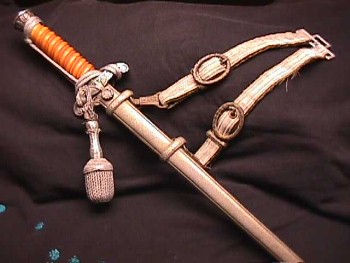
WWII GERMAN ARMY OFFICER'S DAGGER
The Army dagger was initially issued on May 4th, 1935 and was designed by Paul Casburg.
It was produced in three different handle colors; white, yellow and orange. The early
samples were manufactured with a white handle. The earlier daggers were produced by the
Carl Eickhorn factory of Solingen.
The early production daggers had profusely silver plated over nickel for the fittings. The
quality of the plating differ from one manufacturer to the other.
The dagger was worn by various ranks in the army; from officers to individuals holding the
rank of field marshall. However, there was no distinction between the lower and higher rank
officers.
The handle of the Army dagger was constructed from celluloiud and was painted
yellow. A large Army eagle adorned the front of the handguard while the
back was plain and smooth.
The looks of the dagger were complemented by wrapping a portapee around the handle.
The example shown here displays typical wear marks.


|
The portepees are manufactured by hand by braiding and gluing material in a circular
fashion. Portapees added a touch of elegance to daggers and swords and were mainly
displayed in parades and formal occassions.
|
|


The hanger of the dagger was composed of several elements. All of them are illustrated in the
following photographs. The clip was used to attach the hanger to the scabbard. This component was spring
loaded and was adorned by leaves. The buckle was employed to change the lenght of the hanger. This
component was also highly ornate. The last part was the loop. This was used to attach the hanger to the
belt. This was the most simple part, consisting of a plain aluminum construction with no ornamentation
whatsoever.
Also illustrated in this set of pictures is the tip of the scabbard. Often times this part would be damaged
when the dagger was dropped.


Many German edge weapons are currently reproduced.
It is becoming more difficult to be able to tell the fake ones from the real ones because
the quality of the reproductions is improving. The collector must become familiarized with
the construction style and materials employed in the manufacturing of this item.
Attention to the details is critical in order to be able to determine the authenticity of
the collectible.
If you have an interest is seeing other edge weapons of the Third Reich, you can do so by going
to our WWII German daggers and Swords
identification guide, where we discussed edge weapons from different organizations.
| 





 Swat the Shopping Bug to view related military items!


