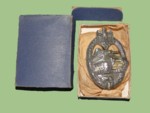
WWII GERMAN BADGE - ARMY BRONZE TANK -
Tank warfare was started in the battlefields of WWI, when lumbering metal giants ran about bringing fear
to the hearts of the enemy combatants that saw them for the first time. But tanks back then were
clumsy, they broke down fairly often and were not very effective. The crewman were exposed to
hazardous conditions breathing toxic fumes.
WWII witnessed a complete revolution in tank warfare. With Hitler's implementation of the Blitzkrieg
strategy, tanks were catapulted center front in combat. Much more sophisticated machines were developed
during this period. They were fast, well armored, maneuverable and well armed.
With the new tanks came a new breed of specialized soldier. The military command decided to
create a badge to recognize the hard work and dedication put forth by tank crewmen.
|
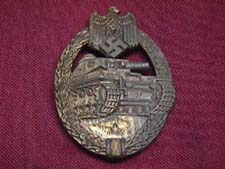
The Tank badge was created on June 1st 1940. The requirements for earning this award were very much like
those established for the Silver Tank badge,
except that this award was allotted for non-tank personnel such as those manning armored vehicles,
self propelled guns, etc. Also eligible for this award were medical personnel who accompanied
the units to battle.
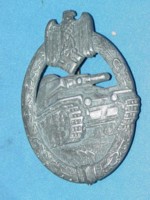
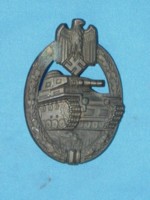
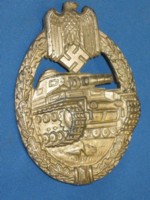
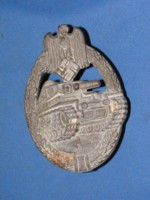
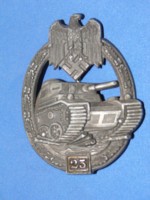
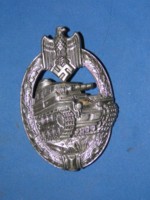
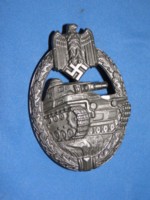
The design of the badge consists of an oval shape wreath with an eagle placed in the upper portion and
the ends of the wreath truncating into a small square in the lower section. The image of a tank is
displayed inside the wreath. Part of the inner track of the tank extends a little beyond the perimeter
set by the wreath.
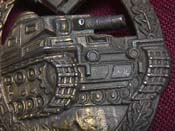
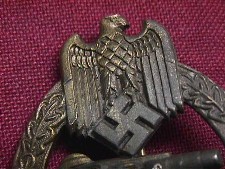
The eagle has its wings retracted with the head facing to the right. The plumeage has very good
detailing. It is clutching a swastika. A portion of the body extends upwardly beyond the wreath. Most of
the body of the tank, including the turret and gun, are clearly visible. The thread and other components
show very clear definition.
|
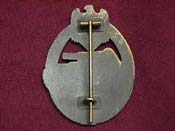
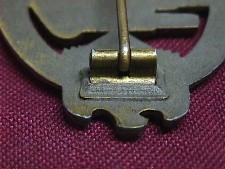
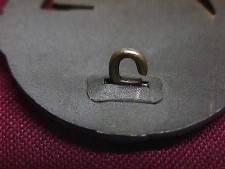
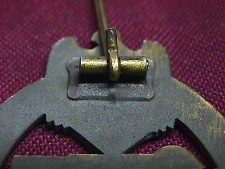
The back of the badge is flat. Notice that this badge is not marked with the manufacturer's
logo. Some
badges had markings while others did not.
|
This page is a recognition and identification guide for WWII German badges and awards. Multiple
detailed photos of a specific sample are provided. Descriptions point out clearly defined points
that should be noted. A
vertical pin , wire type, is hinged at the top and
has a catch in the opposite side. The award was worn on the lower left breast of the uniform by running
the pin through a set of loops (Two or more) that were sewn to the
tunic.
One of the most commonly asked questions is "How much is my WWII German badge worth?". A price
guide is included here to address this question. The value of the badges and awards is reviewed
over a period of several years. A trend can be observed. The present worth of the German
badges in the collector's market is illustrated.
This service is provided free of charge to the visitor/enthusiast courtesy of
MilitaryItems.com,
a company dedicated to the preservation of military history and to providing quality military
antiques and collectibles to museums, institutions and the general public.
|
|
|
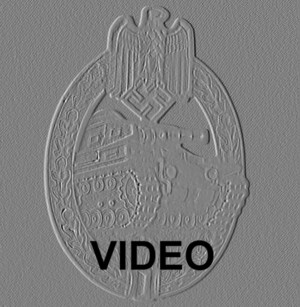
The "Military minute" is a series of instructional videos created by MilitaryItems.com for the purpose of
providing basic information about military collectibles. The idea is to expose people to the exciting
world of military collectibles.
The video presentation coupled with detailed photographs and written information, including a military
collectible's price guide, and anatomical breakdown of each piece enhances the visitor's experience.
Whether you are a long time collector, a beginner or simply have an interest in the history and value of
each collectible, we hope that you find the information presented here useful.
|
The badge was issued in a small paper envelope along with a document that was signed by the
unit's commander.
WWII GERMAN TANK BADGE MANUFACTURERS
There were several companies that produced the tank badge during the war. The followin is a list of the companies.
it is important to note that there may be more manufacturers than those listed here.
| # |
MANUFACTURER |
LOGO |
CITY |
COMMENTS |
1 |
A. D. Schwerdt |
|
Stuttgart |
|
2 |
Adolf Scholze |
|
Grunwald |
|
3 |
Arno Wallpach |
Found on reverse. Placed on right side of the badge. |
Salzburg |
|
4 |
C. E. Juncker |
|
Berlin |
|
5 |
E. Ferd Wiedmann |
|
Frankfurt |
|
6 |
E.W.E. |
|
Unknown |
|
7 |
F. W. Assmann & Sohne |
|
Luedenscheid |
|
8 |
Franke & Co |
|
Luedenscheid |
|
9 |
Frank & reif |
|
Stuttgart |
|
10 |
Friedrich Linden |
Unknown |
Luedenscheid |
|
11 |
Friederich Orth |
Reverse of the badge under the hinge. |
Vienna |
|
12 |
Fritz Zimmermann |
|
Stuttgart |
|
13 |
Gustav Brehmer |
|
makneukirchen |
|
14 |
Hermann Aurich |
|
Dresden |
|
15 |
Hymmen and Co |
Marked L/53 on the back of the badge. |
Luedenscheid |
|
16 |
Josef Feix & Sohne |
|
Gablonz |
This firm made the numbered badges. They did not produce the standard badges.
|
17 |
Karl Wurster |
|
Markneukirchen |
|
18 |
Rudolf Karneth & Sohne |
Logo placed in back under the hinge. |
Gablonz |
|
19 |
Rudolf Suval |
Logo is placed in back center. |
Vienna |
This company made badges during and after the war. Collectors look for the "suval" hinge when identifying replicas.
|
20 |
Rudolf Richter |
|
Schlag |
|
|
|
By the Numbers
It is hard to determine the exact number of Tank bages that were produced. However, thanks to the record
keeping maintained by the Wehrmacht, it is possible to find how many badges were actually issued.
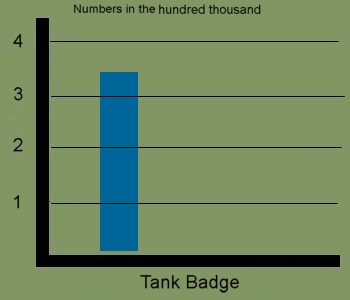 |
There were over 300,000 Tank badges issued during the war.
The Tank badge was issued along with an award document. Not all documents were identical. variations can
be found from unit to unit. A few things that all documents would have in common are the signature of the
officer who awarded the shield and the state seal.
|
|
Collecting Third Reich Badges
Collecting Third Reich memorabilia is a field that has been growing since the days the GI's rummaged around Europe
bringing back military souvenirs. German soldiers wore many of their awards on their uniforms when they went to
battle. Once the soldier was killed or captured, the American soldiers would take the awards as war trophies.
Eventually all these pieces came back to the United States where military history enthusiasts began to collect them.
 |
In trying to determine if you should collect Tank badges there are certain factors that should be
considered.
The adjacent table outlines some of the advantages and disadvantages of collecting the Tank badges.
|
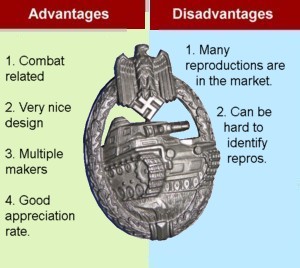 |
This award is currently being
reproduced.
It is becoming more difficult to be able to tell the fake ones from the real ones because the quality
of the reproductions is improving. The collector must become familiarized with the construction style
and materials employed in the manufacturing of this badge. Attention to the details is critical in
order to be able to determine the authenticity of the badge.
If you have an interest is seeing other badges and awards of the Third Reich, you can do so by going
to our
WWII German Badges and Awards
identification guide. Where we cover Heer (Army), Navy (Kriegsmarine) and
Air Force (Luftwaffe) items.
| GERMAN TANK BADGE VARIATIONS |
The German Army Tank badge was produced by several manufacturers and in
different configurations. The following section displays some of the different types
that were manufactured.
|





 Swat the Shopping Bug to view related military items!