|
WWII GERMAN BADGE - ARMY ANTI AIRCRAFT -
The extensive use of aircraft power during WWII demanded a response from ground forces. This gave birth
to the anti-aircraft defenses. The units in charge of fighting off air attacks were issued a badge
in recognition of their efforts. All branches of the service played a role in this field.
The Army badge was very similar in design to that used by the
Luftwaffe . The
Navy played more of a double role with their defenses,
protecting both the sea and air.
The WWII German Army Anti-aircraft badge was instituted on July 18th 1941.
The designer was Wilhelm Peekhaus and the original
manufacturer
was the Juncker firm of Berlin.
Qualifications for the Army Flak badge
The badge was awarded by using a point system. Originally, the soldier would have to perform a series of actions, each worth a certain number of points. The objective being to accumulate 16 points total.
The actions would include successful airplane detection and downing. As the war progressed the requirements
changed to include acts of bravery.
The exact qualifications for earning this award are listed here:
| |
Description of Requirement |
| 1 |
The soldier performs an act of bravery or merit while performing anti aircraft duties.
|
| 2 |
The soldier is wounded while maning the Flak gun in execution of antiaircraft duties.
|
| 3 |
The Flak team member accumulates a total of Sixteen points.
|
| 4 |
Officers commanding the Flak batteries received the Flak badge when half of their team members
earned the badge.
|
|
 |
|
Army Flak badge design
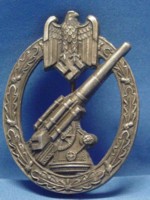
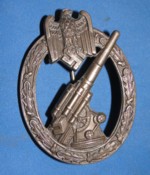
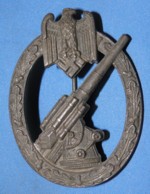
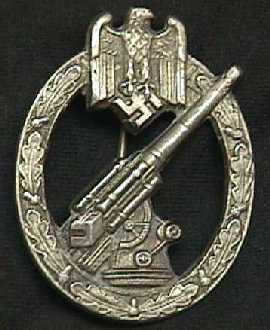
The design of the badge consisted of consisted of an oval wreath with the army eagle placed in the top
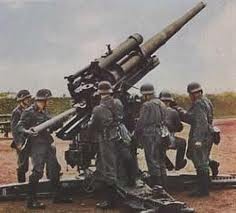
portion. Inside the wreath resides the profile view of the venerable 88 anti-aircraft gun. The
eagle has the wings retracted and its head faces to the right. very nice detailing to the plumeage.
The bird is clutching a swastika. The artillery piece is placed on a base where the mechanisms for
changing its elevation are visible.
Note that the placement of the eagle exposes a portion of its body outside of the wreath. The same
situation occurs with the tip of the artillery piece.
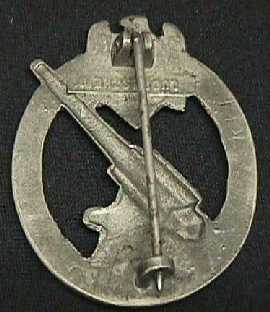
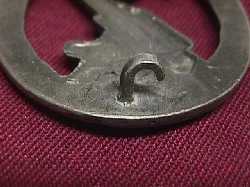
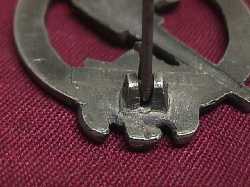
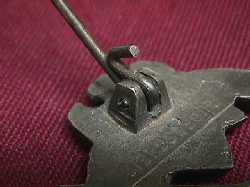
The back of the badge is flat. It has a
vertical pin . Wire type. It is hinged on one
end and has a catch in the opposite side. Examining the photos that follow, the picture on the right
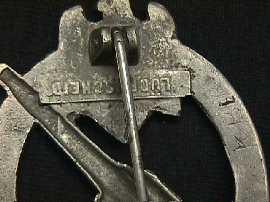
shows a good example of how the pin has an "S" shape. A closer look reveals the existance of a
small indentation on the body of the badge, which matches the bottom of the "S" when the pin is closed.
The name of the manufacturer of the badge is displayed with raised, block letters inside a rectangular
box.
The badge was worn on the chest area of the
tunic by passing the pin through
a series of loops (Two or more) that were sewn to the jacket.
|
|
This page is a recognition and identification guide for WWII German badges and awards. Multiple
detailed photos of a specific sample are provided. Descriptions point out clearly defined points
that should be noted.
One of the most commonly asked questions is "How much is my WWII German badge worth?". A price
guide is included here to address this question. The value of the badges and awards is reviewed
over a period of several years. A trend can be observed. The present worth of the German
badges in the collector's market is illustrated.
This service is provided free of charge to the visitor/enthusiast courtesy of
MilitaryItems.com,
a company dedicated to the preservation of military history and to providing quality military
antiques and collectibles to museums, institutions and the general public.
|
|
|
The "Military minute" is a series of instructional videos created by MilitaryItems.com for the purpose of
providing basic information about military collectibles. The idea is to expose people to the exciting
world of military collectibles.
The video presentation coupled with detailed photographs and written information, including a military
collectible's price guide, and anatomical breakdown of each piece enhances the visitor's experience.
Whether you are a long time collector, a beginner or simply have an interest in the history and value of
each collectible, we hope that you find the information presented here useful.
|
By the Numbers
It is hard to determine the exact number of Army Flak badges that were produced. However, thanks to the record keeping
maintained by the Wehrmacht, it is possible to find how many badges were actually issued.
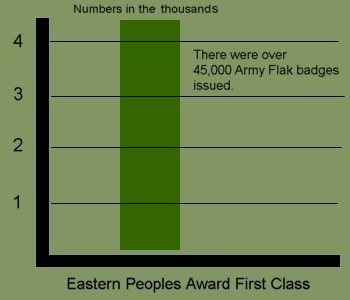 |
There were a total of over 45,000 shields issued during the war. The exact total number is not known to
the author.
The Army Anti-Aircraft badge was issued along with an award document. Not all documents were identical.
variations can be found from unit to unit. A few things that all documents would have in common are the signature
of the commanding officer and the state seal.
|
|
Collecting Third Reich nadges
Collecting Third Reich memorabilia is a field that has been growing since the days the GI's rummaged around Europe
bringing back military souvenirs. German soldiers wore many of their awards on their uniforms when they went to
battle. Once the soldier was killed or captured, the American soldiers would take the awards as war trophies.
Eventually all these pieces came back to the United States where military history enthusiasts began to collect them.
 |
In trying to determine if you should collect Army Flak badges there are certain factors that should be
considered.
The adjacent table outlines some of the advantages and disadvantages of collecting the Army Flak badges.
|
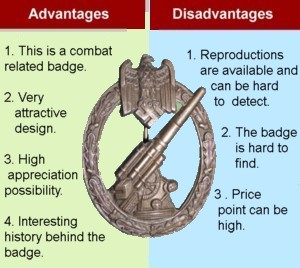 |
This award is currently being
reproduced.
It is becoming more difficult to be able to tell the fake ones from the real ones because the quality
of the reproductions is improving. The collector must become familiarized with the construction style
and materials employed in the manufacturing of this badge. Attention to the details is critical in
order to be able to determine the authenticity of the badge.
If you have an interest is seeing other badges and awards of the Third Reich, you can do so by going
to our
WWII German Badges and Awards
identification guide. Where we cover Heer (Army), Navy (Kriegsmarine) and
Air Force (Luftwaffe) items.
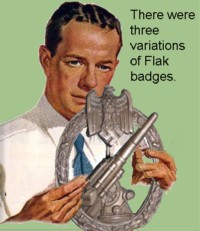
| GERMAN ARMY FLAK BADGE VARIATIONS |
The German Army Flak badge was produced by several manufacturers and in
different configurations. The following section displays some of the different types
that were manufactured.
|



 Swat the Shopping Bug to view related military items!