WWII German Luftwaffe Pilot Badge -
The Luftwaffe is a generic German term for an air force. It is also the official name for two of the four
historic German air forces, the Wehrmacht air arm founded in 1933 and disbanded in 1946; and the current
Bundeswehr air arm founded in 1956. Two other historic German air forces are the World War I-era Luftstreitkräfte
and the Luftstreitkräfte der NVA in the GDR.
On 26 February 1935, Adolf Hitler ordered Hermann Göring to establish the Luftwaffe, breaking the Treaty of Versailles's
ban on German military aviation. Germany violated the treaty without sanction from Britain and France or the League of
Nations, and neither they nor the league did anything to oppose this. Although the new air force was to be run totally
separately from the army, it retained the tradition of according army ranks for its officers and airmen, a tradition
retained today by united Germany's Luftwaffe and by many air forces throughout the world. It is worth noting, however,
that before the official promulgation of Göring's new Luftwaffe in 1935, Germany had a paramilitary air force known as the
Deutscher Luftsportverband (DLV: German air sports union). The DLV was headed by Ernst Udet and its insignia were taken
over by the new Luftwaffe, although the DLV "ranks" had special names that made them sound more civilian than military.

Luftwaffe pilot Ace. |
The pilot's badge was instituted on August 12, 1935 by order of Hermann Goring. the basic design of the badge
consisted of an eagle clutching a swastika. A wreath surrounds the eagle. It is interesting to note that
half of the wreath (left side) is composed of laurel leaves while the other half (right side) consists of
oak leaves.
The German WWII pilot badge was awarded to soldiers attached to the roster of "flying personnel" after they earned
their pilot's license. Personnel who served in the reserves as "standby" pilots also were subject to the same rules.
Individuals who were awarded this badge included Administrative Officials and Luftwaffe Engineering Corps personnel.
There were two basic types of pilot badge. One was made of metal the other was manufactured of cloth. The cloth
badge was identical in design as the metal badge. Embroired releaf where the wreath is silver, the eagle is oxydized
silver and the swastika was a dull aluminum color.
The earlier versions of the badge had a nickel-silver content of 12%. After 1937 the material employed in the
construction was aluminum.
|
the Luftwaffe went into a steady, gradual decline that saw it outnumbered and overwhelmed by the sheer number of
Allied aircraft being deployed against it. Towards the end of the war, the Luftwaffe was no longer a major factor,
and despite fielding advanced aircraft like the Messerschmitt Me 262, Heinkel He 162, Arado Ar 234, and Me 163
was crippled by fuel shortages and a lack of trained pilots. According to records, the last pilot badge was
awarded on May 2nd, 1944.
The following section takes a close look at the metal version of the German WWII pilot badge.

The eagle is attached to the wreath by use of two rivets. A
vertical pin is provided to attach the badge
to the uniform.
The pilot's badge was constructed of various
materials.
Some of them include: Aluminum, zinc, nickel-silver,
plated alloy and tombak. The time period of production will affect the type of material employed.
Earlier badges were traditionally made of nickel, aluminum and tomback. Later war pieces were
manufactured of alloy and zinc.
|
This page is a recognition and identification guide for WWII German badges and awards. Multiple
detailed photos of a specific sample are provided. Descriptions point out clearly defined points
that should be noted.
One of the most commonly asked questions is "How much is my WWII German badge worth?". A price
guide is included here to address this question. The value of the badges and awards is reviewed
over a period of several years. A trend can be observed. The present worth of the German
badges in the collector's market is illustrated.
This service is provided free of charge to the visitor/enthusiast courtesy of
MilitaryItems.com,
a company dedicated to the preservation of military history and to providing quality military
antiques and collectibles to museums, institutions and the general public.
|
|

The badge was worn on the left side of the
jacket.
In the event that the recipient was also awarded the Iron Cross
First class, the pilot badge was placed right under the Iron Cross in a centered fashion.

The pilot badges were often marked with the manufacturer's logo. The sample shown here has been stamped with a
clover shape with the letters "BSW". It is important to note that not all the badges had manufacturing marks.
It is possible to have an authentic WWII German Pilot badge without any markings on it.

|
The "Military minute" is a series of instructional videos created by MilitaryItems.com for the purpose of
providing basic information about military collectibles. The idea is to expose people to the exciting
world of military collectibles.
The video presentation coupled with detailed photographs and written information, including a military
collectible's price guide, and anatomical breakdown of each piece enhances the visitor's experience.
Whether you are a long time collector, a beginner or simply have an interest in the history and value of
each collectible, we hope that you find the information presented here useful.
|
A closer look at the badge reveals great detail work to the wings. The German combat badges are well known for
being manufactured to great quality standards.

Notice that the construction of the hinge is of "barrel" type. the pin itself is a heavy wire type. The catch is
made of a similar material and is attached directly to the wreath. The soldering job to attach the hinge and the
catch is of very good quality. Some of the cheaper badges have the hinge attached to a plate, which is then
soldered to the badge itself.

This picture shows a close up look at the German WWII Pilot badge pin catch. This is how the pin was secured shut.
PHYSICAL PROPERTIES
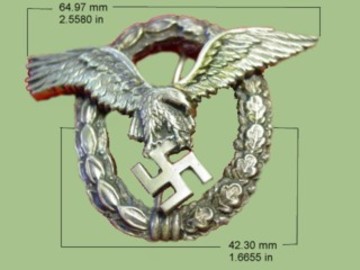
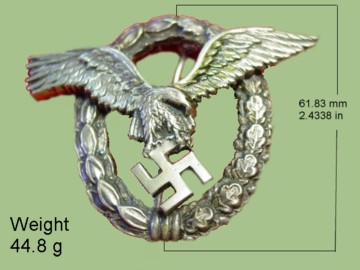
The physical properties of a badge are a very important aspect to consider when determining
the authenticity of a badge. The information provided here covers the badge shown on this
page. It is important to note that there are variations among manufacturers.
This badge is currently being
reproduced. It is becoming more difficult to
be able to tell the fake ones from the real ones because the quality of the reproductions is improving.
The collector must become familiarized with the construction style and materials employed in the
manufacturing of this badge. Attention to the details is critical in order to be able to determine
the authenticity of the badge.
If you have an interest is seeing other badges and awards of the Third Reich, you can do so by going
to our WWII German Badges and Awards
identification guide. Where we cover Heer (Army), Navy (Kriegsmarine) and
Air Force (Luftwaffe) items.
MILITARY PRICE GUIDE INFORMATION
The value for WWII German Combat badges and other military antiques and collectibles is provided
as a means to educate the collector community and individuals who have a general interest on the
field. The following is an estimated value. Prices may vary in every state and every country.
This service is provided courtesy of
MilitaryItems.com.
The source for military antiques and collectibles in the web.
| Year |
2006 |
2007 |
2008 |
2009 |
2010 |
2011 |
2012 |
2013 |
2014 |
2015 |
| Value |
$875.00 |
$925.00 |
$1,000.00 |
$1,100.00 |
$1,100.00 |
$ |
| Availability |
Medium |
Medium |
Medium |
Rare |
Rare |
|
| Invest Grade |
A |
A |
A |
A |
A |
A |
While the item featured here is not for sale, similar items like it are available for
purchase in our website MilitaryItems.com
|