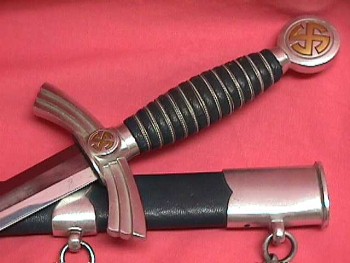
WWII GERMAN LUFWAFFE FIRST MODEL DAGGER
The Luftwaffe instituted the use of a dagger in 1934. The dagger was designed
based on an earlier piece used by the DLV.
There were two types of Luftwaffe 1st model daggers produced; the
first type had nickel fittings while the second type had aluminum fittings.
This page features the aluminum dagger but at the end pictures are provided to
compare both samples.
There are two main types of Luftwaffe 1st model daggers produced; the
first type had nickel fittings and was the earlier type. The second type had aluminum fittings
and was introduced in late 1935. One reason for the change was to achieve a more modern look.
In addition, the same type of material wa employed in the manufacture of some airplanes.
Both models are illustrated on this page. The nickel type is first, followed
by the aluminum fittings dagger.
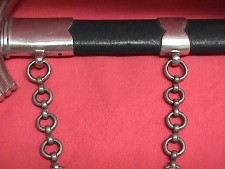
A distinguishing feature of the 1st model daggers is the hanger which was permanently
attached to the body of the scabbard. A clip located at the end of the hanger was employed
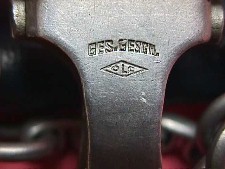
to attach the piece to a carrying belt. The manufacturer's brand can be seen on the close-up
picture of the clip.
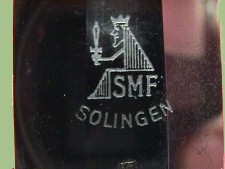
There were several makers producing this item. Among the most common are found:
| MANUFACTURER NAME |
LOCATION OF FACTORY |
| Carl Eickhorn |
Solingen |
| F W Holler |
Solingen |
| E F Horster |
Solingen |
| E P & S |
Solingen |
| J A Henckels |
Solingen |
| W K C |
Solingen |
| Paul Weyersberg |
Solingen |
| S M F |
Solingen |
| Carl Julius Krebs |
Solingen |
| Gbr Heller |
Solingen |
The number of companies that produced daggers is large. It is possible to have other manufacturer's who produced
teh dagger and do not appear on this list.
|
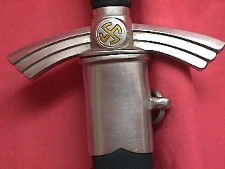
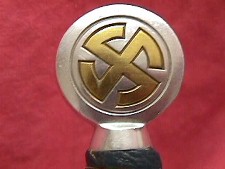
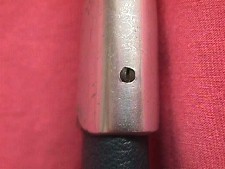
The pommel of the dagger is very prominent and bears a golden cross. The screws used to assemble
the scabbard are shown here. The guilding in the swirled swastika was often worn off due
to normal wear. It is hard to find a sample as nice as the one shown here.
|
|
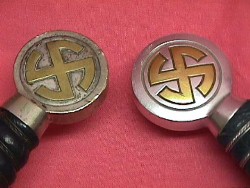
ALUMINUM vs NICKEL
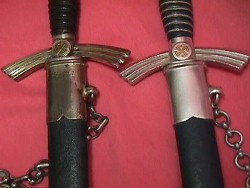
A comparison between the construction of the aluminum dagger and the nickel dagger follows.
The daggers made from aluminum tend to be in better condition because the material does not
deteriorate as rapidly. Notice the difference between the main bodies and the pommel.
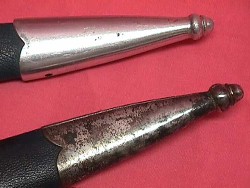
In another sharp contrast both scabbard tips are shown together here. Aluminum is brighter
and remains cleaner than nickel.
This edge weapon is currently being
reproduced. It is becoming more difficult to be
able to tell the fake ones from the real ones because the quality of the reproductions is improving. The
collector must become familiarized with the construction style and materials employed in the manufacturing
of edge weapons. Attention to the details is critical in order to be able to determine the authenticity
of the item.
If you have an interest is seeing other edge weapons of the Third Reich, you can do so by going to our
WWII German Edge Weapons identification guide. Where
we cover blades from the Heer (Army), Navy (Kriegsmarine), Air Force (Luftwaffe) and other organizations.
| 





 Swat the Shopping Bug to view related military items!


