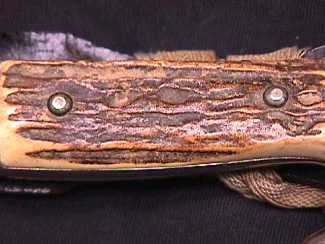
WWII GERMAN BAYONET - STAG HANDLE
The Third Reich produced a large number of edge weapons for all types of organizations. The
military forces were issued daggers, swords and bayonets.
Under the regime of the Third Reich, civilian organizations, such as the fire department and
police had a para-military nature. They were often seen as an extension of the Nazi party. As
such, they were also issued blades such as the one featured here.
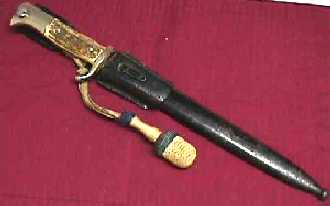
|
The 98K bayonet was the standard bayonet for the German armed forces during World War Two.
There were multiple versions of this bayonet. The most common one was the one employed
for combat .
There were other bayonets whose purpose was purely symbolic. These were known as
parade bayonets. The sample shown here
falls into this category.
The parade bayonets could be customized in different ways. Everything depended on how much
money the owner wanted to spend to show his pride. Some of the upgrades that could be purchased
from the factory included the use of engraved blades.
|
The design of the bayonet was almost identical to a 98K bayonet. All metal parts were chromed
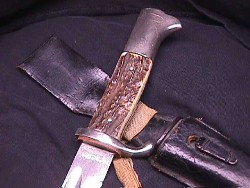
to make the piece more attractive. The handle is covered with stag. the pommel is the "dove"
head type, named after its similarity to the profile of a bird's head. The scabbard is of
metal construction. Painted black. A portapee has been added to make the bayonet more
elegant. A black leather frog is secured to the scabbard. The blade is fully chromed.
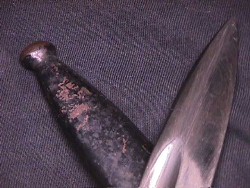
A closer view of the upper section of the bayonet and its scabbard can be seen here (below-left). The tip of the
blade and the scabbard are featured as well (below-right). The blade of the bayonet is in mint condition. The scabbard
shows some paint wear.
|
This page is a recognition and identification guide for German bayonets. Multiple
detailed photos of a specific sample are provided. Descriptions point out specific
points that should be noted.
One of the most commonly asked questions is "How much is my German bayonet worth?".
A price guide is included here to address this question. The value of the Nazi bayonets is
reviewed over a period of several years. A trend can be observed. The present worth
of the police sword in the collector's market is illustrated.
This service is provided free of charge to the visitor/enthusiast courtesy of
MilitaryItems.com,
a company dedicated
to the preservation of military history and to providing quality military antiques and
collectibles to museums, institutions and the general public.
|
|
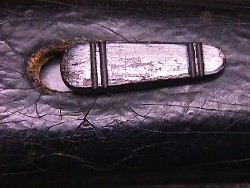
The scabbard has a stud which allows that protrudes from one side. This feature allows the
attachment of the frog to the scabbard.
Some cracking on the black leather can
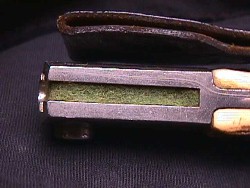
be seen as the piece has dried up due to age (below-left). The rail that permits the bayonet to
be attached to a rifle still contains the packing material. This material may have been put in
place by the manufacturer (below-right). These bayonets were never meant to be affixed to a rifle.
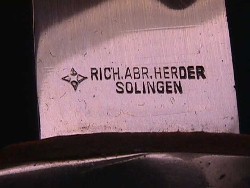
Like in many other edge weapons, the base of the blade is marked with the
logo of
the manufacturer, which consisted of a four pointed star followed by the name RICH. ABR. HERDER.
The name of the town (Solingen) where the blade was manufactured is engraved just below the logo.
Solingen was a well renown town for the manufacturing of edge weapons.
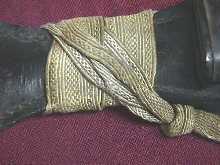
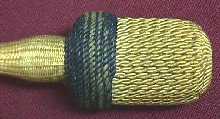
The scabbard of the example featured on this page comes with a tassle and ball. Normally these
items were placed on the bayonets when they were to be worn during parades or formal occassions.
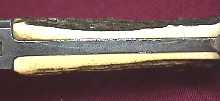
Some reproductions of this bayonet are appearing in the market. One way to
identify the reproductions is to inspect the sides of the handle. The picture
below illustrates how the stag on the handles is of uneven width while the
reproduction pieces tend to be more even.
This edge weapon is currently being
reproduced. It is becoming more difficult to be
able to tell the fake ones from the real ones because the quality of the reproductions is improving. The
collector must become familiarized with the construction style and materials employed in the manufacturing
of edge weapons. Attention to the details is critical in order to be able to determine the authenticity
of the item.
If you have an interest is seeing other edge weapons of the Third Reich, you can do so by going to our
WWII German Edge Weapons identification guide. Where
we cover blades from the Heer (Army), Navy (Kriegsmarine), Air Force (Luftwaffe) and other organizations.
|





 Swat the Shopping Bug to view related military items!


