WWII GERMAN GOLD WOUND BADGE -
Towards the end of the Spanish civil war, several German soldiers were wounded prompted. This prompted
Hitler to reinstitute an award dating back to WWI, the wound badge. The year was 1939, the design that was
selected was very similar to that employed during the great war, the main difference being that the new
badge sported a raised swastika on the helmet.
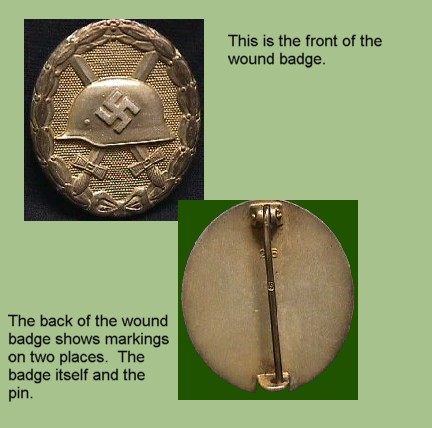
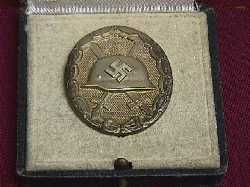
The design consists of an oval shape with a wreath surrounding its perimeter. The area inside the
wreath has heavy pebbling. The profile of a German helmet (Type M-35) is placed in the center of the badge.
A swastka is positioned in the center of the helmet. A pair of crossed swords is located behind the helmet.
The shape is stamped so it is raised in the front. The back is solid and smooth.
A
vertical pin
is provided to secure the badge to the
tunic
of the owner. This was accomplished by putting the pin through a series of loops (two or more)
that were sewn to the breast area of the jacket. The pin is hinged on one end and has a catch on the other.
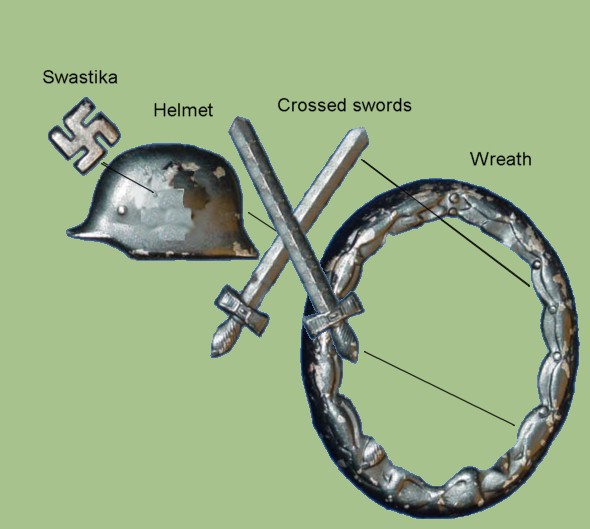
The designers of the Gold wound badge used items that were important to the German military complex as well as
the people in general. The following is an outline of the items and the possible motivation for their use.
| Laurel with berries |
Helmet |
Swords |
Swastika |
 |
 |
 |
 |
|
The Laurel is native to the Mediterranean region. It is the source of the bay leaf used in cooking. It figures
prominently in classical Greek, Roman, and Biblical culture.
|
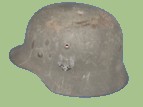
The German helmet was re-designed in 1935. Loosely based on the same model as used during WWI. The new helmet was
shorter, had ventilation rivets and a roled edge.
|
The sword has long been a symbol of strength. The German Saxon tribes employed the sword in combat for generations.
|
The Swastika was chosen by Hitler as the symbol of the Third Reich. It was displayed in just about every military
and civilian award.
|
CRITERIA FOR AWARD
The wound badge was issued in three classes: Black ,
silver and
gold .
The appearance of the badges was identical with the exeption of the color.
At the start the badge was issued to military personnel from all branches. As the war progressed and the allied
bombing campaigns intensified the award was extended to cover civilian personnel who were injured during the attacks.
This change came about by order of Dr Goebbels in 1943.
The criteria for earning the award follows:
 |
| | CLASS | CRITERIA |
 |
Black Wound badge |
Issued to soldierd who received one to two wounds.
|
 |
Silver wound badge |
1. Awarded to soldiers who received three to four wounds.
2. One wound resulting in the loss of hand, foot, eye or causing defness.
|
 |
Gold wound badge |
1. Given to soldiers for getting wounded five or more times
2. Issued to soldiers who were totally disabled, permanently blind or lost their
manhood as a result of a wound.
|
The only illness that qualified for receiving the wound badge was frostbite. This was a common ailment in the
Eastern front.
|
A document was issued with every badge. It is important to note that the award documents came in a variety of
designs. Not one was the standard version. The example shown here is one of the documents employed. Other
documents of different format may have been employed.
The Gold Wound medal was presented in a box which often did not have any depictions or markings. A very
similar type of presentation can be found for the Silver Wound badge.
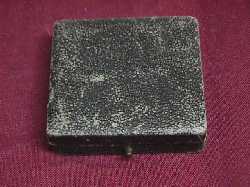
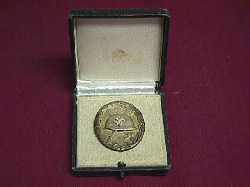
The award was issued in a box. Black in color. The lid is hinged to one end via the use of metal hinges.
When the box is in the open position, the hinges cannot be seen from the inside of the box because a
section of cloth is provided to hide them. A button activated latch is built to the opposite end of the
hinges. This mechanism secured the lid shut when in the closed position.
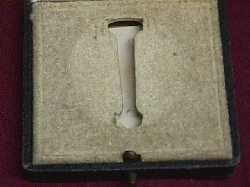
The inside of the box has a cutout made to fit the back portion of the badge, normally this area is covered
with a black felt cloth. The piece featured here is missing that feature. It consists of plain cardboard.
|
This page is a recognition and identification guide for WWII German badges and awards. Multiple
detailed photos of a specific sample are provided. Descriptions point out clearly defined points
that should be noted.
One of the most commonly asked questions is "How much is my WWII German badge worth?". A price
guide is included here to address this question. The value of the badges and awards is reviewed
over a period of several years. A trend can be observed. The present worth of the German
badges in the collector's market is illustrated.
This service is provided free of charge to the visitor/enthusiast courtesy of
MilitaryItems.com,
a company dedicated to the preservation of military history and to providing quality military
antiques and collectibles to museums, institutions and the general public.
|
|
|
The "Military minute" is a series of instructional videos created by MilitaryItems.com for the purpose of
providing basic information about military collectibles. The idea is to expose people to the exciting
world of military collectibles.
The video presentation coupled with detailed photographs and written information, including a military
collectible's price guide, and anatomical breakdown of each piece enhances the visitor's experience.
Whether you are a long time collector, a beginner or simply have an interest in the history and value of
each collectible, we hope that you find the information presented here useful.
|
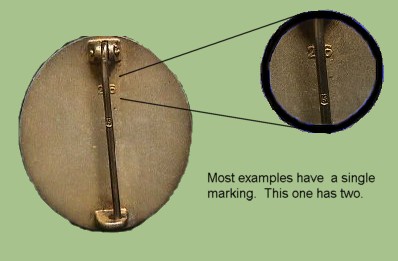
The back of the gold wound badge is normally marked. However, there may be instances where this did
not occur. The example shown here has two
markings.
One is placed on the body itself. The other is
located in the pin. Notice that both numbers match (See pictures below). This indicates that the
pin and badge were manufactured at the same factory and at the same time.
Markings that are this extensive normally were applied to higher end badges.
BY THE NUMBERS
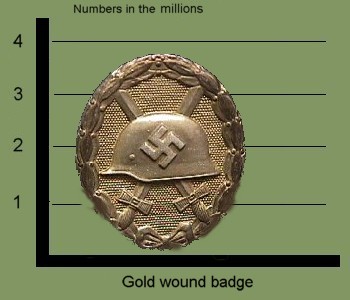
It is hard to determine the exact number of Gold wound badges that were produced. However, thanks to the record
keeping maintained by the Wehrmacht, it is possible to estimate how many crosses were actually issued. The number
stands well above 4 million.
The actual number of Gold wound badges produced is greater than the number that was issue. It must be accounted that the
armed forces would have a stock in hand so it could replace lost ones and issue new awards. In addition the factories
were likely to have warehouses with inventory at hand. The Iron Cross was one of the awards most widely distributed
during WWII.
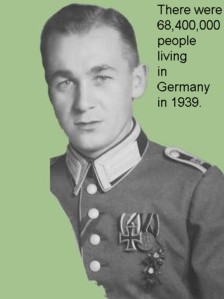
The population of Germany in 1939 was approximately 64,000,000.
COLLECTING GOLD WOUND BADGES
Collecting Third Reich memorabilia is a field that has been growing since the days the GI's rummaged around Europe
bringing back military souvenirs. German soldiers wore many of their awards on their uniforms when they went to battle.
Once the soldier was killed or captured, the American soldiers would take the awards as war trophies. Eventually all
these pieces came back to the United States where military history enthusiasts began to collect them.
|
"I am trying to figure out if I should get into collecting Gold wound badges."
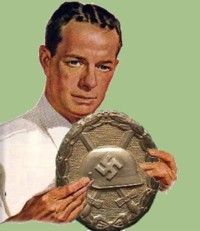 |
Determining which military badges to collect can be a challenging decision. The combination of availabiilty and
cost will often set the pace of what can be collected.
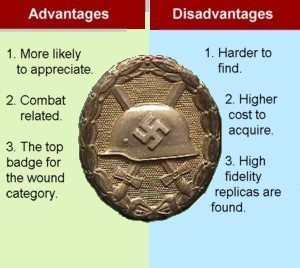
The adjacent table outlines some of the advantages and disadvantages of collecting the Gold wound badge.
|
|
|
| WWII GERMAN GOLD WOULD BADGE VARIATIONS |
The following are a series of examples of the German gold wound badge. It is a good practice for the collector of
German WWII memorabilia to become familiarized with as many examples of a given badge. This experience enhances the
ability to detect fakes vs real.
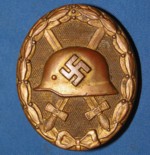
WWII GERMAN GOLD WOUND BADGE - 1
This is a German wound badge. Gold class. As issued during WWII.
|
This award is currently being
reproduced.
It is becoming more difficult to be able to tell the fake ones from the real ones because the quality
of the reproductions is improving. The collector must become familiarized with the construction style
and materials employed in the manufacturing of this badge. Attention to the details is critical in
order to be able to determine the authenticity of the badge.
If you have an interest is seeing other badges and awards of the Third Reich, you can do so by going
to our
WWII German Badges and Awards
identification guide. Where we cover Heer (Army), Navy (Kriegsmarine) and
Air Force (Luftwaffe) items.
| 





 Swat the Shopping Bug to view related military items!