WWII GERMAN BADGE - HIGH SEAS FLEET -
This is a WWII Fleet War badge. This badge was established on April 30th, 1941. It was designed by Adolf
Bock of Berlin. The criteria for receiving the badge was to have proof of distinction and good conduct
in the execution of missions inside a battleship or cruiser, for at least 12 weeks.
Other qualifying criteria included:
| 1 |
When the mission was particularly effective and the individual showed great leadership or was killed in action.
|
| 2 |
Survivors of ships that were sunk by the enemy. Or if the crew member was wounded during action.
|
| 3 |
For participating in two missions near Iceland.
|
|
The "Military minute" is a series of instructional videos created by MilitaryItems.com for the purpose of
providing basic information about military collectibles. The idea is to expose people to the exciting
world of military collectibles.
The video presentation coupled with detailed photographs and written information, including a military
collectible's price guide, and anatomical breakdown of each piece enhances the visitor's experience.
Whether you are a long time collector, a beginner or simply have an interest in the history and value of
each collectible, we hope that you find the information presented here useful.
|
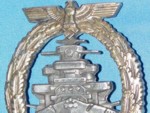
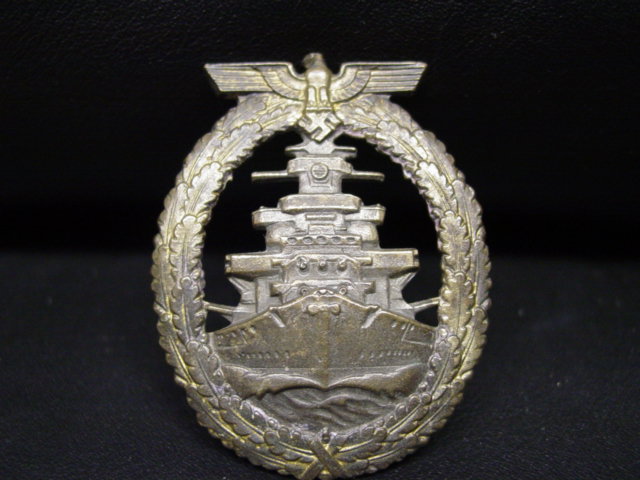
The shape of the badge is that of an oval wreath. An eagle has been placed in the upper portion of the oval.
It has the wings spread out and the head faces left. As with most badges, the eagle is clutching a
swastika. Right below that is the frontal view of a destroyer. The waves at the bow are parting as to
indicate motion. The main guns are facing forward. Nice detailing to windows. Very sharp and square.
Other components of the ship have similar definition. Normally the wreath would be guilded, however, it is common for the color to wear out through normal use and time. The color turns into a shade of silver/gray.
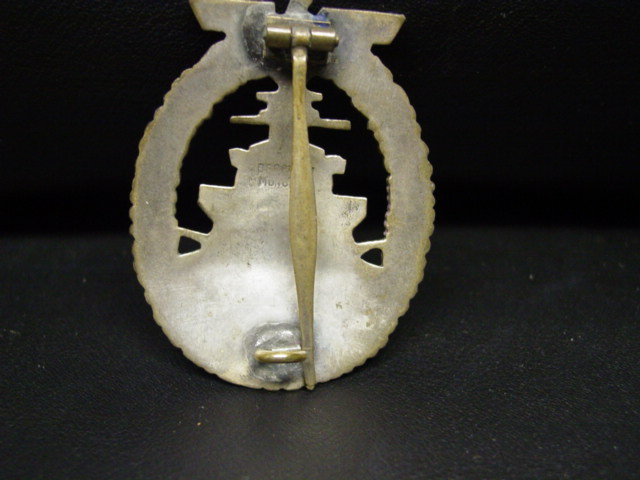
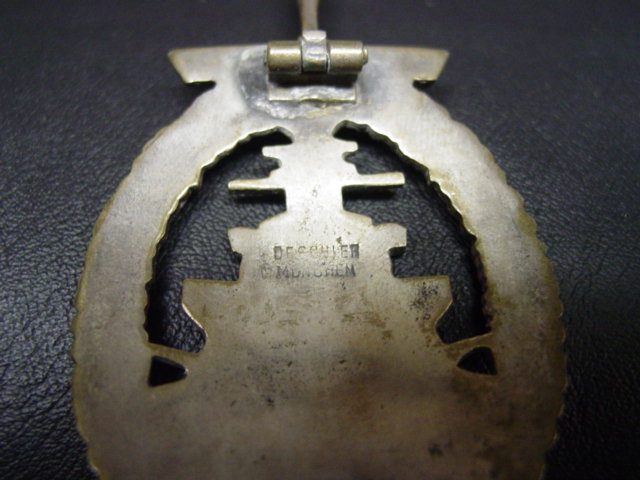
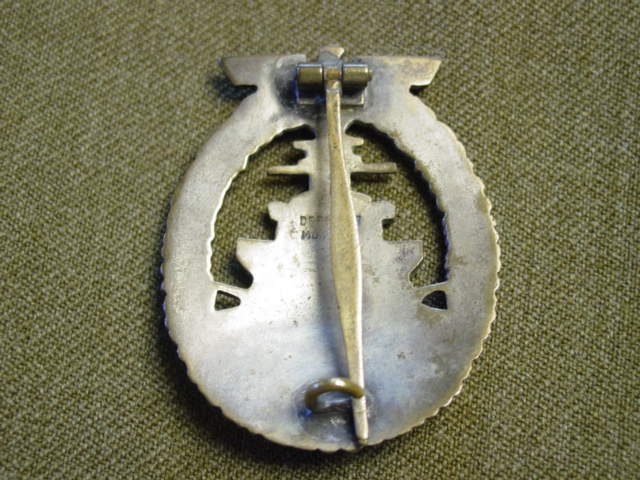
The back of the badge is plain and has a slight convex shape to it. A vertical "Coke" shape
Pin is provided. It is Hinged at the top and has
a catch at the opposite side that secures it in the closed position. The back also shows
Manufacturing
marks. They are stamped near the center and read "DEFCHIER - Munchen".
The sailor would wear the badge by passing the pin through loops sewn onto the
jacket.
|
This page is a recognition and identification guide for WWII German badges and awards. Multiple
detailed photos of a specific sample are provided. Descriptions point out clearly defined points
that should be noted.
One of the most commonly asked questions is "How much is my WWII German badge worth?". A price
guide is included here to address this question. The value of the badges and awards is reviewed
over a period of several years. A trend can be observed. The present worth of the German
badges in the collector's market is illustrated.
This service is provided free of charge to the visitor/enthusiast courtesy of
MilitaryItems.com,
a company dedicated to the preservation of military history and to providing quality military
antiques and collectibles to museums, institutions and the general public.
|
|
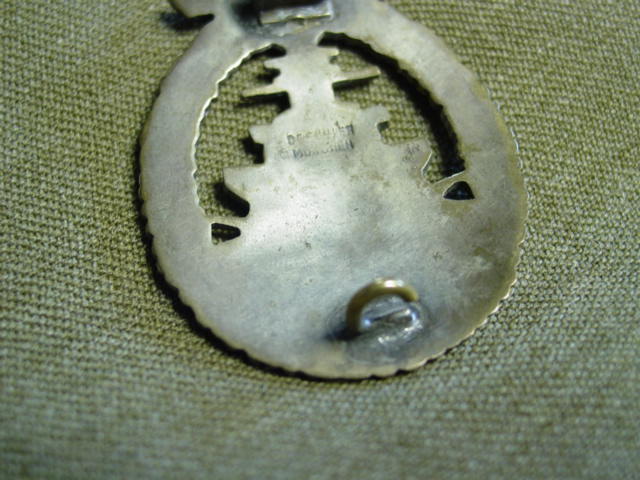
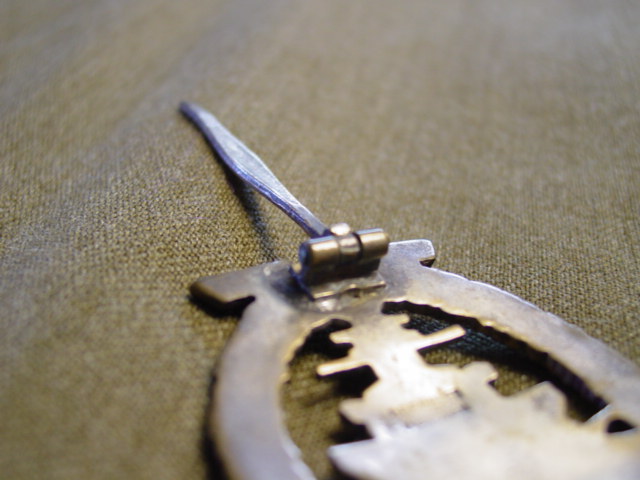
This is a closer view of the hinge for the pin and its hinge. It is details like this one
that help identify the real badges from the
fake ones.
The collector must pay attention to all aspects of construction. Things such as the shape of the
pin, the type of tip of the pin and others become very important when determinig authenticity.
The picture below shows some left over solder where the hinge has been attached to the body.
This is an indication of field repair. Since sailors actually wore these awards while on
duty, it is not uncommon to see damage to them. The badge may have been snagged by a pipe
while the sailor was moving, causing the hinge to come off. The person could promptly fix
it by soldering back.
This award is currently being
reproduced.
It is becoming more difficult to be able to tell the fake ones from the real ones because the quality
of the reproductions is improving. The collector must become familiarized with the construction style
and materials employed in the manufacturing of this badge. Attention to the details is critical in
order to be able to determine the authenticity of the badge.
If you have an interest is seeing other badges and awards of the Third Reich, you can do so by going
to our
WWII German Badges and Awards
identification guide. Where we cover Heer (Army), Navy (Kriegsmarine) and
Air Force (Luftwaffe) items.
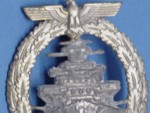
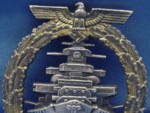
| GERMAN HIGH SEAS BADGE VARIATIONS |
The High Seas badge was produced by several manufacturers and in different configurations. It is a good idea for all
military collector's to review as many examples as possible of a badge. This practice will enhance your knowledge
and give you a better chance to detect a reproduction. The following section displays some of the different types
that were produced.
|




 Swat the Shopping Bug to view related military items!